
From Covid to climate change, Shankar Acharya's look at some of the trends and events that might shape 2022.

Troops of India and China were locked in a 73-day-long standoff in Doklam from June 16 last year after the Indian side stopped the building of a road in the disputed tri-junction by the Chinese army.

New Delhi should resist any temptation to act as spoiler and instead should cooperate with its SCO partners in reaching a regional consensus behind the formation of an interim government in Kabul, argues Ambassador M K Bhadrakumar.

The Western powers appear to regard Delhi as the most logical destination in the region in these extraordinary times -- as a counterpoint to the ascendance of political Islam and a rising red star over Afghanistan, observes Ambassador M K Bhadrakumar.

'The credit for managing Trump should go to Modi.' 'Biden is a predictable and rational person with plenty of administrative experience,' notes Ambassador T P Sreenivasan.
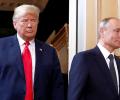
The stagnation in US-Russia relations does not augur well for New Delhi's strategic interests, says Harsh V Pant and Raj Kumar Sharma.

India and Japan have a shared interest in countervailing China's hegemonic ambitions in Asia. Although neither has an interest in forming an overt anti-China alliance, Tokyo and New Delhi feel increasingly obligated to work together to find ways to guard against a muscular Beijing's power sliding into arrogance, says Brahma Chellaney.

Pak seeks US help to ease tensions with India.

The Americans have expended a lot of diplomatic energy to coax India into toeing their line but India has refused to buckle under pressure. As Foreign Minister Subrahmanyam Jaishankar said, India has not taken anyone's side but its own side, points out Virendra Kapoor.

It will not be to India's advantage to create misperceptions that it is bandwagoning with some Anglo-American project for regime change in Myanmar, argues Ambassador M K Bhadrakumar.
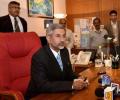
He said that if there are issues that need to be talked about, it is between India and Pakistan.

Both Mahinda Rajapaksa and Modi have learnt from their past mistakes. Modi has understood that Rajapaksa is a 'forever politician' that India has to live with, observes Ambassador M K Bhadrakumar.

General Mattis has been the most steadfast champion in Trump's cabinet of the US-India defence relationship. If Trump chooses a more pliable successor, the Pentagon's attention could go off India.

Whether it liked it or not, the Ukraine crisis forced India to choose between the aggressor Russia and the US-led free world, a decision it hated to make, Virendra Kapoor points out. In the end, it abstained from the vote in the Security Council.

Modi has the chance to break out of India's passive mode and firmly tell Russia that in this day and age, India will not support unilateral invasions, asserts Harishchandra Dighe.
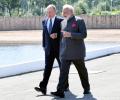
'The Vladivostok visit marks a subtle reversal of trend discernible in the revival of India-Russia relations pioneered by Modi during the past couple of years,' says Ambassador M K Bhadrakumar.

Assistant Secretary for South and Central Asian Affairs Nisha Biswal will travel to Bangalore and New Delhi from March 4 to 6

'China is constantly probing India's weaknesses.' 'The challenge is to implement a strategy that will allow India to buy time, gather its strength, and eventually counter China,' recommends Harsh V Pant and Vinay Kaura.
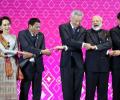
The Modi government has to embrace the history of Tamil conquests in South East Asia and stop obsessing about Babar/Humayun, argues Colonel Anil A Athale (retd).

'India would not like to see Pakistani domination and tutelage of Afghanistan against Indian security and economic interests.'

Trump telephoned Modi to congratulate him on the historic electoral victory in the Lok Sabha polls, the White House said.

'The potential of one such LAC engagement going out of control and leading to heavy casualties cannot be ruled out,' warns Lieutenant General Syed Ata Hasnain (retd).

World leaders thanked India for its help and support in combating the coronavirus pandemic through "early and meaningful" shipments of COVID-19 vaccine doses, as they addressed the high-level UN General Assembly session this year.

The US has been, historically, a sleeping partner in India-China relations. Today, any attempt by the Modi government to make a bilateral move to improve relations with Beijing could upset Biden's apple cart, notes Ambassador M K Bhadrakumar.

India and Brunei on Tuesday emphasised the need for a peaceful solution to the South China Sea issue through discussions as Vice President Hamid Ansari held wide-ranging talks with the top leadership here, with the two sides signing three agreements including on defence.

The Blinken visit indicated that the Biden administration is still somewhat tentative about the specifics of its relations with India, observes Ambassador T P Sreenivasan, who has served multiple stints at India's embassy in Washington, DC.

But why should India be talking to the Taliban in the first place? There is no love lost there. India will never forget or forgive the humiliation to which the Taliban subjected it in the IC-814 hijack, notes Shekhar Gupta.

The Obama administration has christened his vision of Indo-US ties that has overcome the "hesitations of history" and working for the betterment of the global good as "Modi Doctrine".
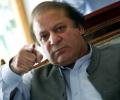
India on Friday said the Nawaz Sharif government in Pakistan has given 'good signals" in normalising bilateral ties but cautioned against expecting "magic overnight".

Tuesday's talks between Modi and Trump are likely to send across a clear message of growing congruence of interests between India and the US on major geopolitical developments in the region and beyond, particularly when China has been expanding its military and economic clout.
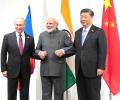
'Russia is the only country that can act as facilitator for any eventual Chinese-Indian rapprochement,' points out Ambassador M K Bhadrakumar.

Biden has reiterated America's support for India's permanent membership on a reformed UNSC and its entry into the NSG during his first in-person bilateral meeting with Modi at the White House.
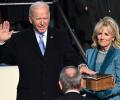
World leaders said they were looking forward to working with Joe Biden, as they welcomed the 46th President of the United States with praise and took parting shots at his predecessor Donald Trump.
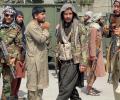
'Imagine China pursuing its aims in Jammu and Kashmir by using Pakistani and now Afghan proxies.'

COVID-19 has emerged as an important form of diplomatic currency around the world as nations try to showcase their soft power gains. In this race, India has an edge as India is already a pharmaceutical giant having produced some 60 per cent of global vaccines and now justly seeking to strengthen ties and expand its influence in its neighbourhood and beyond, observes Dr Rajaram Panda.

'Movement of naval forces at sea is often more than just perfunctory deployment -- reading the messages that they send is important,' alerts Vice Admiral Premvir Das (retd).

'The sooner Pakistan and India face these geopolitical realities, the better it will be for their own security and prosperity,' observes Ambassador M K Bhadrakumar.

China is going to be an indispensable partner in Russia's ongoing crisis with the US, while on its part, China cannot remain indifferent if Russia gets crushed by the US, lest it loses 'strategic depth', observes Ambassador M K Bhadrakumar.

'Wherever in the world there is political instability, those countries are beset with severe crises today. But India is in a much better position than the rest of the world due to the decisions taken by my government in the national interest,' President Droupadi Murmu said in her address to both Houses of Parliament.

At war, the Jalashwa can carry and launch a full infantry battalion in a single wave. At peace, the Jalashwa can evacuate 1,000 people in a single trip. Ajai Shukla explains why the Indian Navy's new tender for more ships like the Jalashwa must be treated with special urgency.
